Dr. Alaina Steck's Summer Conference sessions highlight two of the most fascinating intersections of wilderness medicine: managing rabies exposures in remote environments and uncovering how nature's deadliest toxins have shaped modern medicine. WMS Ambassador Aidan Smith recently spoke with Dr. Steck about her passion for toxicology, the challenges of practicing in austere settings, and what attendees can expect from her interactive presentations.
Q: You have training in emergency medicine, medical toxicology, and addiction medicine. What got you interested in all three?
A: It’s a winding story. Initially I was torn between Peds and Emergency Medicine, but at the end of the day I felt most at home in the Emergency Department, which to this day is strange to me because it is 100% at odds with my personality—I hate unpredictability, interruptions, chaos … so, basically 99% of any given day in an ED. But I certainly have that EM mindset of enjoying several different things at once, which made it hard to decide on a fellowship. I knew going into residency that I was interested in Critical Care, Wilderness Medicine, Medical Toxicology, and Pediatric EM. I actually applied to both Tox and Wilderness fellowships, but at the end of the day, Tox won out: on the first day of my Tox rotation in residency, I walked into the regional poison center, saw chemical structures on the whiteboard, and immediately thought, “Oh, these are my people!”.

Dr. Steck’s love of biochemical pathways exemplified. (Credit: Dr. Steck)
I never saw Addiction Medicine coming. While in my first year of Tox fellowship, Dr. Tim Wiegand gave a grand rounds lecture to our program on the neurobiology of addiction. It was one of the coolest things I had ever seen, and I was hooked.
Q: You practice at one of the busiest trauma centers in the Southeast while also serving as Associate Medical Director for the Georgia Poison Center. What does your day-to-day look like in those two roles?
A: I have a really unusual set-up, and I have to thank the people who advocated for me to carve out this incredibly unique career. My Med Tox time is spent seeing bedside consults with our students, residents, and fellows—everything from undifferentiated presentations to snake bites to overdoses—and serving as the medical backup for the poison center, which takes calls from all over Georgia. When I’m not covering the Tox service, I work in our outpatient Addiction Medicine clinic roughly eight days each month, work on a handful of research projects, and teach pharmacology at the school of medicine. It’s ever-changing and busy, but it certainly keeps me from being bored!
Q: When providers mismanage a plant or venom exposure, what are the most common errors you see, and how can they be corrected or prevented in the future?
A: Thankfully, I would say we don’t see mismanagement too often—providers usually call the poison center for guidance quite promptly, since these exposures are pretty uncommon for anyone who doesn’t practice Toxicology regularly. One of the common scenarios we do run into is the question of whether an envenomated limb needs a fasciotomy. North American pit vipers can produce tissue damage and symptoms that mimic compartment syndrome—patients will frequently have tense, swollen limbs; intense pain that appears out of proportion to exam findings; and paresthesia or altered sensation. So, we recommend that providers always check compartment pressure if there is concern for compartment syndrome. Compartment syndrome is rare following a snakebite but can occur. If compartment pressures are indeed elevated, the recommended treatment is not fasciotomy—instead, patients should receive additional doses of anti-venom.
Q: Toxic plant and venom exposures vary so much by region. Have you ever encountered something in the field that puzzled you?
A: Oh my goodness, all the time! The most notable example I have is from when I was still a Toxicology fellow, working at the Centers for Disease Control and Prevention. I was part of a team that was deployed to Mozambique to help investigate the cause of an outbreak of sudden deaths that occurred in a rural community. It took months and some truly brilliant inter-agency collaboration before we got an answer. The culprit toxin turned out to be something called bongkrekic acid, a heat-stable toxin produced by a specific bacterial strain that grows on corn and soy products under specific temperature and humidity conditions. It was the first time such an outbreak had been reported on the African continent.
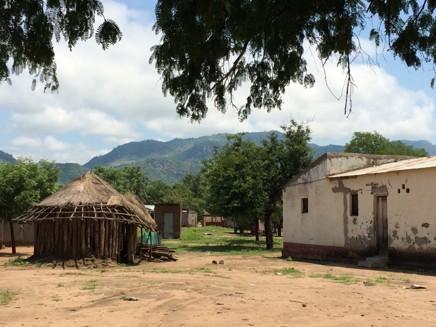
Chitima municipality in Mozambique. (Credit: Dr. Steck)
Q: I've seen recent literature suggesting there is a push to abandon the Milwaukee protocol for rabies treatment. What do you think? If this protocol is abandoned, where does that leave us in treating patients with symptomatic rabies?
A: I think it leaves us in the same place we are now—with an essentially untreatable disease. I’ve yet to see any convincing evidence that the Milwaukee protocol is superior to any other intensive treatment regimen, though this is also because the numbers are so small. There are only about three dozen reported cases of survival, compared to the millions of people who have died from human rabies infection in the same time frame.
Q: For someone in a remote setting facing a potential rabies exposure and days from hospital care, what decision-making framework would you want them to have?
A: For the most part, we can consider rabies post-exposure prophylaxis (PEP) as a medical urgency rather than a medical emergency. The single most important thing is to provide the best wound care possible. Excellent irrigation of the bite can decrease the amount of virus that remains in the wound; reducing the viral load increases the amount of time it takes for the virus to travel through the peripheral nerves to the central nervous system. A bite to the face or neck is the most urgent, because incubation periods with these wounds have been reported to be as few as three days, so timely PEP is needed. In contrast, PEP can be delayed up to 7 – 10 days in the case of extremity bites if access to care is not immediately available (though prompt treatment is still ideal).
Q: Emergency medicine is arguably the most direct route into wilderness medicine, but your specializations in toxicology and addiction medicine show that providers can pursue areas they are interested in while still participating in wilderness medicine. I plan to pursue ENT, which is not directly connected to wilderness medicine. What advice do you have for medical students interested in non-emergency medicine specialties who still want to participate in wilderness medicine?
A: Enjoy your chosen specialty and your passion for Wilderness Medicine! Over the years I’ve had so many people ask, “How do you plan to use X, Y, or Z?” as though I need to justify my interests. You don’t have to have a reason to learn and get excited about something new; it doesn’t have to fit into some overall master plan. Work is hard enough—find parts of it that give you joy, even if it seems irrational to other people.
Q: In your bio, you mention biking, your dog, and getting lost in the mountains. What does time outdoors give you that the emergency department and poison center cannot?
A: Peace. There is something about being outside, especially in the mountains, that takes the weight of the world off my shoulders.
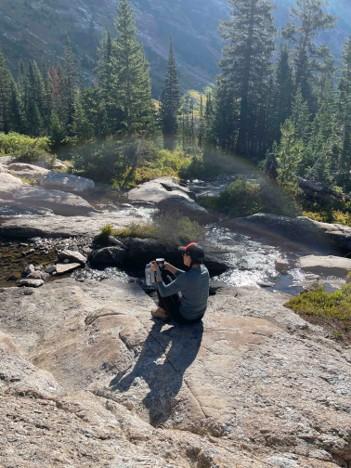
Dr. Steck adventuring in the Teton Mountain Range. (Credit: Dr. Steck)